




Off Christopher Street is available on Apple Podcasts, Spotify, Amazon Music, YouTube, Pocket Casts, and many more. (Click here to see all platforms).
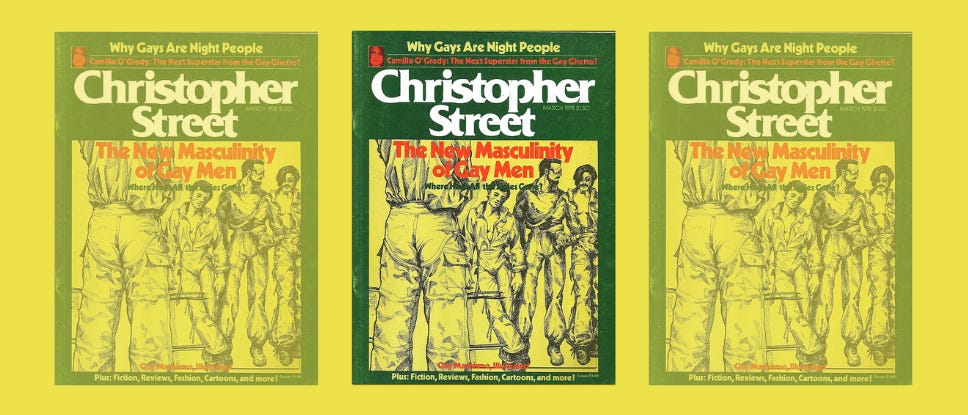
In this episode of Off Christopher Street, we talk about the rise of so-called gay macho in the 1970s, which cultural commentators both inside and outside the gay world connected to the new prominence of the clone, the leather bar, and a cultural fascination with BDSM. We take a look at the March 1978 issue of Christopher Street, which bore the cover line: “The New Masculinity of Gay Men: Where Have all the Sissies Gone?”
Reporting from The Anvil, a New York leather bar that would soon serve as a filming location for William Friedkin’s Cruising (1980), the academic Seymour Kleinberg was not happy about this masculine turn in gay culture, which he saw as a betrayal of the political radicalism of sixties androgyny and gay men’s alliance with feminists in the women’s movement.
We discuss different gay stances in relation to feminism, and the idea, still with us today, that gender-bending is inherently radical—or that being more effeminate, and therefore a more abject political subject, confers some kind of ethical authority. We reflect on the long tradition in the gay world of complaining that other gays are being gay the wrong way. And we speculate about the origins of our erotic fascination with masculinity and the importance of being able to revel in what we find hot without overthinking it.
Sources
Seymour Kleinberg, “Where Have All the Sissies Gone?,” Christopher Street, March 1978.
Bruce Schulman, The Seventies: The Great Shift in American Society, Culture, and Politics (2002)
Susan Sontag, “Fascinating Fascism,” The New York Review of Books, February 6, 1975.
Edmund White, “Fantasia on the Seventies,” Christopher Street, September 1977.
Edmund White, City Boy: My Life in New York in the 1960s and 1970s (2009)
Quentin Crisp, The Naked Civil Servant (1968)
Seymour Kleinberg, Alienated Affections: Being Gay in America (1980)
Midge Decter, “The Boys on the Beach,” Commentary, September 1980.
Larry Kramer, The Tragedy of Today’s Gays (2005)
Brian Pronger, The Arena of Masculinity: Sports, Homosexuality, and the Meaning of Sex (1990)
Amia Srinivasan, “Does Anyone Have the Right to Sex?,” London Review of Books, March 22, 2018.
Anastasia Berg, “Wanting Bad Things: Andrea Long Chu Responds to Amia Srinivasan,” The Point, July 18, 2018.
Leo Bersani, Homos (1995)
You can also listen—and subscribe!—to Off Christopher Street on Spotify, Apple Podcasts, and YouTube. If you listen on one of those platforms, please take a moment to give us a rating and a review, which helps other listeners find us.


